Seventy percent of digital transformation initiatives still fail to meet their objectives in 2025. That stubborn statistic, confirmed by Boston Consulting Group and McKinsey research, has barely budged in two decades. More alarming still, Bain’s 2024 analysis reveals that 88% of business transformations fail to achieve their original ambitions. According to PMI research, organizations waste $97 million for every $1 billion invested due to poor project performance.
The numbers prompt an uncomfortable question: if so much is known about why initiatives fail, why do organizations keep making the same mistakes? The answer lies not in a lack of intelligence or resources, but in a phenomenon researchers call institutional amnesia. Organizations learn fast and forget almost as quickly, limiting their ability to make use of relevant past experiences. They invest billions in knowledge management systems and lessons learned programs, yet somehow lose access to their own history at precisely the moments when that history matters most.
The Forgetting Epidemic Hidden in Plain Sight
Institutional amnesia is among the biggest constraints to decision-making excellence and a massive contributor to productivity shortfalls. Yet in practice, there seems to be little awareness of its occurrence and the severe long-term impact it can have. As one academic analysis noted, the understanding of how organizations lose memory over time is still in its infancy and fragmented.
The condition manifests in predictable patterns. Projects restart solutions that failed before, unaware of the documented reasons for prior failure. Teams reinvent processes that other departments perfected years ago. Executives repeat strategic pivots that predecessors attempted and abandoned. New leaders purge the ideas and programs of their predecessors without evaluating their merit, setting the stage for another round of organizational amnesia down the road.
Wikipedia’s entry on corporate amnesia puts it bluntly: organizations with institutional amnesia are likely to keep trying to periodically replicate solutions that have not worked in the past, unsuccessfully implement solutions others have successfully applied but in different contexts, and fail to value the knowledge of long-term staff.
The Project Management Institute has tracked this phenomenon extensively. In one study of an organization that had been in business for 100 years, researchers found that the institution lost its bearings about every 20 years, which equates more or less to one generation. As each generation of leadership handed over control to the next, the corporate memory took a severe hit.
The Architecture of Organizational Forgetting
How exactly do organizations lose their memory? Researchers have identified four primary mechanisms that drive institutional amnesia.
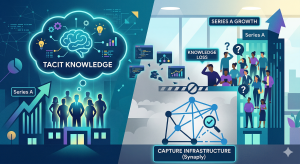
The first is organizational churn. In today’s fast-paced work environment, employees change jobs more frequently than ever. This leads to a loss of institutional knowledge and experience when people leave, especially if knowledge transfer processes are not in place. The collective awareness of tacit knowledge and forms of practice that provides an organization’s adhesive and lubricant walks out the door with every departure.
The second mechanism is what researchers call absorptive capacity failure. New information and lessons compete for attention with ongoing operational demands. Organizations lack the cognitive bandwidth to process and integrate learnings from completed projects while simultaneously managing current ones. The urgent consistently crowds out the important.
The third driver involves strategic-instrumental decision making. When leaders change, they rarely take over new positions only to carry on the same priorities as their predecessors. More often, the departing leader’s priority programs suffer through a period of benign neglect until they are consigned to the scrap heap. What gets forgotten is that those past programs and processes existed for a reason, usually arising as a reaction to some past disaster now lost in the mists of organizational history.
The fourth mechanism is the failure of historical storytelling. Organizations create narratives about themselves that selectively remember and forget based on current priorities. Inconvenient lessons get suppressed. Flattering interpretations get amplified. The actual history of what worked and what failed becomes distorted beyond recognition.
The Search for Lost Knowledge
The problem of institutional amnesia connects directly to how employees spend their time. According to the latest Pryon report, 47% of average professionals spend one to five hours every day searching for specific information. Another 15% spend six to ten hours doing the same. Employees spend an average of 3.6 hours daily searching for information, contributing to increased burnout, according to Bloomfire’s 2025 knowledge management trends analysis.
This means that nearly half the workforce loses a substantial portion of each workday not creating value, but hunting for knowledge that should already be accessible. The KM World Survey Report reveals that 54% of organizations use more than five different platforms for documenting and sharing information among employees. This fragmentation ensures that even when lessons have been captured somewhere, finding them proves nearly impossible.
The pattern repeats itself: organizations document insights in one system, file decisions in another, store project outcomes in a third, and scatter related communications across email, messaging platforms, and meeting notes. A recent eGain study on knowledge management found that 36% of participants have three or more knowledge management tools in use, with 31% of employees not knowing how many knowledge management tools they even have.
When the next project begins, nobody can locate what was learned from the last one. The organization has not failed to learn; it has failed to remember.
The Lessons Learned Paradox
Most organizations claim to conduct lessons learned exercises. Few actually benefit from them. The PMI research identified giving only lip service to lessons learned as a primary cause of organizational amnesia. Those of us who have been through project terminations know the myriad activities that result, including the quest for follow-on jobs for the project team, and those urgent tasks often take priority over well-intentioned activities like documenting what went wrong.
Even when lessons are captured, they rarely transfer. According to research on knowledge loss impacts, the requisite managerial competencies normally assumed for senior management positions are insufficient to minimize the negative impacts of corporate memory loss. Effective knowledge management and knowledge transfer within the organization are fundamental for ongoing organizational effectiveness, yet most organizations treat them as afterthoughts.
The digital transformation failure rate illustrates the consequences. A 2025 MIT report listed an eye-popping 95% failure rate for enterprise generative AI pilot projects, defining failure as those not showing measurable financial returns within six months. Projects stall in the proof-of-concept phase, costs spiral, or outputs prove unreliable when scaled, because organizations cannot access what they learned from previous technology implementations.
The Project Management Institute’s 2025 Pulse of the Profession report found that about 80% of enterprise projects met business goals, meaning one in five did not. That 20% failure rate, multiplied across thousands of projects annually, represents enormous waste, waste that compounds when organizations cannot learn from what went wrong.
The Human Memory Fallacy
Organizations often assume that employees will remember what matters. This assumption proves dangerously incorrect. Tacit knowledge, the non-technical understanding of how things actually get done, is acquired largely through experience that is functional, context-specific, and institution-specific. Much of it is implicit and ambiguous, residing in the heads of experienced workers who rarely write it down.
The problem is that, as one researcher observed, because of the high levels of job churn in the modern workplace, much of the mind-resident tacit knowledge is now non-existent within organizations. Employers believe that the imported tacit knowledge from employees hired from other institutions is an adequate stand-in. It is not. Every organization develops its own culture, processes, and unwritten rules. New hires from outside cannot substitute for employees who understood how things actually worked.
The PMI study documented a particularly insidious variation of this problem: the case of the discredited leader. When a senior leader is forced out in disgrace, the organization often purges that leader’s protégés and policies regardless of their merit, destroying institutional memory at warp speed. Not all of that leader’s ideas were bad ones, but it did not matter. The stage was set for another round of organizational amnesia.
Why Knowledge Management Has Not Solved the Problem
Organizations have invested heavily in knowledge management systems for decades. The global knowledge management market is expected to reach $2.1 trillion by 2030. Yet the problem persists because traditional approaches focus on the wrong things.
Most knowledge management initiatives emphasize documentation: capturing explicit knowledge in databases, wikis, and repositories. But as the research on institutional memory makes clear, explicit knowledge represents only a fraction of what organizations need to retain. The physical evidence of documentation is known as explicit knowledge while the more cerebral is called tacit knowledge. Both are integral for efficient decision-making and experiential learning to build on success and escape the pandemic of repeated mistakes, re-invented wheels, and other unlearned lessons that litter modern industry.
According to the KM World Survey Report, 51% of respondents state they would benefit from a visual diagram or search capability to better deliver information across their enterprises. Similarly, 58% say their training processes could be accelerated from a visual diagram or search capability. Organizations know their knowledge systems are inadequate but lack the tools to connect information across silos.
The 2025 analysis from Gartner noted that only about 48% of projects fully meet or exceed their targets. The gap between what organizations know and what they can access at the moment of decision continues to drive project failure, strategic missteps, and repeated mistakes.
Building Organizational Memory That Actually Works
Escaping the institutional amnesia trap requires a fundamental shift in how organizations think about knowledge. Rather than treating knowledge management as a documentation exercise, leading companies are building what might be called organizational intelligence systems. These systems connect knowledge across silos, make lessons accessible at the moment of decision, and preserve context alongside content.
Platforms like Synaply represent this new approach, focusing not just on capturing what happened but on making organizational memory searchable, contextual, and actionable. The goal is ensuring that when a project team faces a challenge, they can immediately access how similar challenges were addressed before, what worked, what failed, and why.
The Deloitte Customer Service Excellence report found that only 33% of customer service managers believe their agents can easily find the information needed to aid customers. The remaining 67% find it moderate or difficult. This gap between available knowledge and accessible knowledge defines the institutional amnesia problem.
Solving it requires three capabilities that traditional knowledge management lacks. First, cross-functional visibility: the ability to connect knowledge across departments, functions, and systems that would otherwise remain siloed. Second, temporal context: preserving not just what was decided but when, why, and what conditions shaped the decision. Third, active surfacing: pushing relevant past experience to current decision-makers rather than requiring them to search for it.
The Implementation Roadmap
Organizations can begin addressing institutional amnesia through specific interventions at three levels.
At the project level, teams should document not just outcomes but reasoning. The goal is capturing the logic behind decisions, not merely the decisions themselves. When conditions change, future teams need to understand whether original assumptions still hold. This requires going beyond traditional lessons learned to include decision rationale, rejected alternatives, and conditional factors.
At the organizational level, companies should invest in knowledge systems that connect rather than fragment. The proliferation of five or more documentation platforms that 54% of organizations now use guarantees that knowledge will be lost. Consolidating around integrated platforms that make knowledge searchable and connected prevents the fragmentation that enables forgetting.
At the cultural level, organizations must recognize that knowledge preservation is a strategic priority, not an administrative burden. When organizations waste $97 million for every $1 billion invested, and failed IT projects alone cost $50 to $150 billion annually in the United States, the accumulated cost of institutional amnesia becomes staggering. Companies that treat organizational memory as infrastructure rather than overhead will outperform those that do not.
The Competitive Advantage of Remembering
As one researcher put it, what is the point of learning if lessons learned are quickly forgotten? The organizations that master institutional memory will compound their advantages over time. Each successful initiative will inform the next. Each failure will genuinely teach, not simply recede into the past.
The companies still struggling with 70% transformation failure rates in 2025 are not lacking in talent, technology, or resources. They are suffering from a disease of forgetting that makes them repeat expensive mistakes their predecessors already made and documented, somewhere, in systems no one can access anymore.
The cure for institutional amnesia is not more documentation. It is organizational intelligence that makes the past accessible to the present, ensuring that hard-won lessons actually inform current decisions. In a business environment where knowledge increasingly determines competitive outcomes, the ability to remember what your organization already knows may be the most undervalued capability of all.