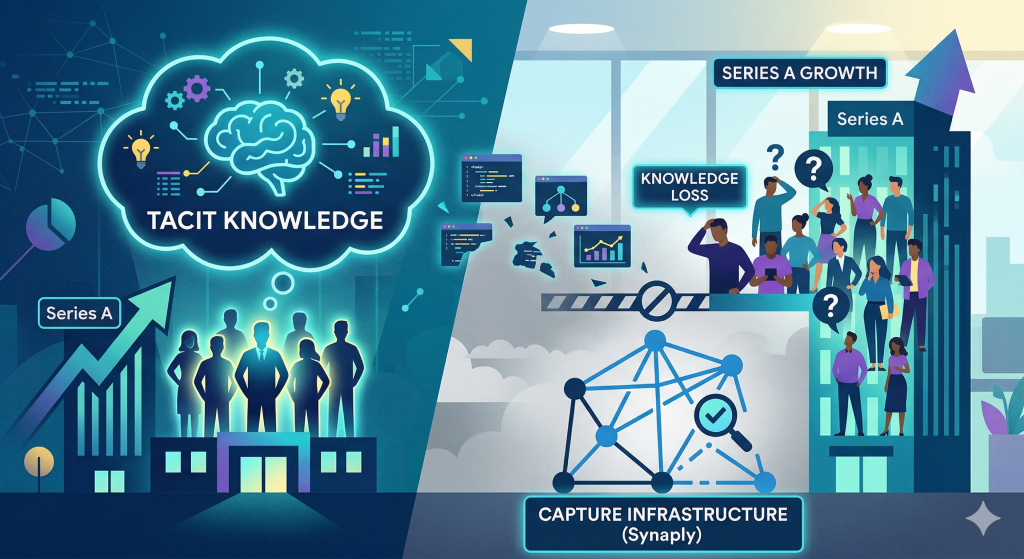
What is tacit knowledge? Tacit knowledge is the expertise, judgment, and context that lives in people’s heads rather than in documents. It includes how decisions actually get made, why certain approaches work at your specific company, and the institutional patterns that took years to develop. Unlike explicit knowledge (written documentation), tacit knowledge is hard to transfer and nearly impossible to recover once it’s gone.
Series A is the moment when companies are supposed to accelerate. You have product-market fit. You have capital. You have a team that knows how to win.
You also have a knowledge problem you don’t know about yet.
Between the seed stage and Series A, most of your institutional knowledge lives in three to ten people who were there from the beginning. They know why certain decisions were made. They know which customers gave feedback that shaped the product. They know which approaches failed and why.
Then you hire. Fast. And none of that knowledge transfers automatically.
How Series A Growth Accelerates Knowledge Loss
The average Series A company doubles headcount within 18 months of closing the round. Every new hire starts without context. Every promotion creates a gap between the person who had the institutional knowledge and the role they just vacated.
This is not a new problem. But AI is making it significantly worse.
A 2026 paper by MIT economists Daron Acemoglu, Dingwen Kong, and Asuman Ozdaglar identified what they call “knowledge collapse”: when AI handles enough of the decision-making work, people stop generating the public signals that build collective knowledge. Short-term efficiency gains come at the cost of long-run erosion of the organization’s shared knowledge base.
At Series A companies, this plays out in a specific way. AI tools are reducing the human-to-human interactions where tacit knowledge used to transfer. Engineers fix bugs by prompting Claude instead of asking a senior colleague. Sales reps draft outreach with AI instead of working through the pitch with a manager. Every AI-assisted shortcut is also a missed knowledge transfer moment.
The Three Moments When Tacit Knowledge Disappears
1. When a key employee leaves
IDC estimates Fortune 500 companies lose $31.5 billion annually from failing to share critical information. At Series A scale, the math is smaller but the concentration is worse. One engineer leaving can take 18 months of architectural context with them. One sales leader departing can mean losing the understanding of why three enterprise deals closed and why two didn’t.
The knowledge doesn’t disappear when they hand in their laptop. It disappears in the months before, as the company failed to capture it.
2. When AI sessions stay private
In 2025 and 2026, every engineer on your team has a private AI session history. Every product manager has a Claude or ChatGPT thread where they worked through a problem, made a decision, and got to an answer.
That thread is invisible to the organization. The decision made at 11pm in a private AI session becomes the direction of the feature, but the reasoning never gets captured anywhere. The next engineer to work on that feature starts from zero.
A 2026 Gartner survey found that 47% of digital workers struggle to find information needed to do their jobs. AI tools are generating more decisions faster. They are not making those decisions more findable.
3. When junior roles disappear
Junior employees have been the transfer mechanism for tacit knowledge in professional services for decades. Proximity to seniors. Correction in real time. Repetition over years. That’s how expert judgment moved from one generation of practitioners to the next.
As AI handles more work that used to be done by junior hires, the transfer mechanism breaks down. Banking, consulting, law, and engineering are all experiencing this simultaneously. The knowledge doesn’t just stop being transferred. It stops being generated in transferable form.
What the Research Says: The Scale of the Problem
A 2026 Gartner survey found that 47% of digital workers struggle to find information needed to do their jobs effectively. Employees spend nearly 20% of their working time searching for information that already exists inside their organization (McKinsey Global Institute). 42% of essential expertise lives only in employees’ heads, never documented anywhere (Harvard Business Review).
The AI knowledge management market reached $11.24 billion in 2026, growing at a 46.7% annual rate. Capital is flowing into this category because the problem is now visible enough to fund.
For Series A companies specifically, the cost compounds differently than it does at enterprise scale. You don’t have the documentation infrastructure of a 5,000-person company. You don’t have the HR budget for structured knowledge transfer programs. And you’re moving fast enough that the gap between what you know and what’s written down widens by the week.
Why Traditional Knowledge Management Tools Fail at Series A
The default response to knowledge loss is documentation. Write it down. Build a Notion wiki. Create Confluence pages.
This approach has two problems at Series A scale.
First, documentation requires someone to decide that a piece of knowledge is worth capturing, stop what they’re doing, and write it up in a way that will be useful to someone else. At a company where everyone is running at capacity, this almost never happens.
Second, documentation tools are filing systems. They organize knowledge that already exists in written form. They do nothing to capture the knowledge that lives in AI sessions, verbal decisions, and the heads of your most experienced people.
A 2026 Gartner report identified context graphs as the new essential infrastructure for AI agent systems. Context graphs capture decision logic, workflows, and institutional knowledge in a structured, queryable format. But you can’t build a context graph from a Notion wiki. You need a capture layer that intercepts knowledge at the moment it’s created.
Documentation Tools vs. Knowledge Capture Infrastructure
| Documentation Tools (Notion, Confluence) | Knowledge Capture Infrastructure (Synaply) | |
|---|---|---|
| When knowledge is captured | After the fact, when someone decides to document | At the moment decisions and insights are created |
| What gets captured | Explicit knowledge someone chose to write down | Tacit knowledge, AI session outputs, decision context |
| Structure | Filing system for existing content | Schema that shapes thinking before submission |
| AI agent readiness | Documents require processing before they’re queryable | Structured inputs, ready for agent retrieval |
| Failure mode | Knowledge that’s never documented is never captured | Nothing; capture is built into the workflow |
| Maintenance burden | High; requires ongoing curation | Low; capture happens as a byproduct of work |
How to Build a Knowledge Capture Layer That Actually Works
The companies that will have institutional memory advantage in three years are not the ones building the best documentation. They’re the ones building capture infrastructure now, while the knowledge is still accessible.
Here’s what that looks like in practice.
Capture at the point of decision, not after the fact
The highest-value knowledge is generated at the moment a decision is made. The context, the tradeoffs considered, the information that shaped the choice. Waiting to document this after a sprint retro or a quarterly review means you capture the conclusion, not the reasoning.
Capture infrastructure intercepts knowledge at the point it’s created. Not a Slack channel where you tell people to share learnings. A structured system that shapes how knowledge gets submitted.
Structure the input, not just the storage
Most knowledge management tools let you put anything anywhere. That’s the problem. Unstructured knowledge is hard to retrieve, hard to compare across submissions, and nearly impossible to use as training data for AI agents.
Structured knowledge capture means defining the schema before the input. Not “tell me what you learned” but “what decision did you make, why did you make it, what were the tradeoffs, what would need to be true for this decision to be wrong.” The schema shapes the thinking. The thinking produces better knowledge.
Make it a workflow, not a project
Knowledge capture fails when it’s treated as a documentation project with a start and end date. It works when it’s built into the workflow that already exists.
The best implementations are ones where knowledge capture happens as a byproduct of work that was already happening: the post-call debrief, the sprint retrospective, the customer feedback session. The capture layer attaches to the existing workflow rather than creating a new one.
Frequently Asked Questions
What is the difference between tacit knowledge and explicit knowledge?
Explicit knowledge is documented and transferable: process docs, code comments, meeting notes. Tacit knowledge is the judgment, expertise, and contextual understanding that lives in people’s heads. It’s hard to articulate, hard to transfer, and almost impossible to recover once the person who holds it is gone. Most of the knowledge that determines organizational outcomes is tacit, not explicit.
Why does knowledge loss accelerate at Series A?
Series A growth creates rapid headcount expansion, new roles, and faster decision-making cycles. Most founding-team knowledge was never documented because there was no need to share it across a larger team. Scaling creates the need for institutional memory at the same moment it disrupts the informal transfer mechanisms that existed when the team was small.
Can AI tools replace tacit knowledge?
No. AI tools can retrieve documented knowledge more efficiently, but they cannot replace knowledge that was never captured. If the reasoning behind a decision never made it into any system, no AI tool can surface it later. AI improves retrieval. It does not solve capture.
How do you capture tacit knowledge from employees who are leaving?
The best approach is not an exit interview. By the time someone is leaving, the window for structured knowledge transfer is nearly closed. The better approach is continuous capture built into the workflow: structured debriefs after key decisions, AI session summaries routed to a shared knowledge layer, and insight templates that prompt specific knowledge types before the person is in transition.
What is a knowledge capture layer?
A knowledge capture layer is infrastructure that intercepts knowledge at the moment it’s created, structures it for future retrieval, and makes it queryable by both humans and AI agents. Unlike a documentation tool (which organizes knowledge that someone chose to write down), a capture layer is designed to surface and structure knowledge that would otherwise never be recorded.
What is the ROI of investing in knowledge capture at Series A?
The most direct ROI is reduced onboarding time and reduced decision re-litigation. McKinsey estimates employees spend 20% of their time searching for information they need. If a 20-person Series A team spends even 10% less time on knowledge search, that’s the equivalent of two full-time hires. The compounding ROI comes later: organizations with structured knowledge infrastructure build context graphs faster, onboard AI agents more effectively, and lose less competitive advantage when key employees leave.
How is Synaply different from Notion or Confluence for knowledge capture?
Notion and Confluence are filing systems. They organize knowledge that already exists. Synaply is capture infrastructure. It intervenes upstream, providing structured templates that shape how knowledge is submitted at the moment it’s created. The result is structured, queryable knowledge that doesn’t require curation after the fact.
Most Series A companies discover they have a knowledge problem when a key person leaves and nobody knows why three critical decisions were made. By then, the knowledge is already gone.
The organizations that avoid this are the ones that build the capture layer before they need it.